Recent demonstrations in public spaces of our cities are confirming a profound crisis of political institutions worldwide. While citizens are claiming a change in national political agendas to ask for more focus on their own everyday life concerns and less on global finances, public squares are emerging as places of political discussion. Moved by this contemporary interest, Intermediate Unit 8 have worked on redefining what constitutes a public space today, which is the role of the architect and the agency of people, and how innovation on fabrication methods might serve as fundamental tools for constructing a city of the commons.
This year the work of the unit has been located in the city of Mexico, a metropolis developed under neoliberal rules for the last two decades. The particular site for the unit work has been the massive modernist housing complex of Tlatelolco, and more specifically, the Plaza de las Tres Culturas. This urban square is well known not only for the mixed presence of Aztec, Spanish Colonial and Modernist constructions, but also for its past political life including the students’ massacre before 1968 Olympic Games. Based on a confrontation with the everyday life in the city, students have researched on the most “mundane” contemporary issues, including insecurity, informal economy, drug cartels, social segregation or cultural repression. These issues are the ones employed as alternative micro-agendas to inform the public space of today. After intense research and reflection on the realities of the city, students have proposed different material and programmatic tactics, reflecting on how traditional construction methods can be used to generate new fabrication techniques in which citizens have a more active role. Therefore, social participation and public action are considered a fundamental part in the definition of new political spaces as an endless process of contestation, negotiation and transformation.
24.2.12
W20 - Tutorials
10.30 Anand
11.00 Erez
11.30 Andrew
12.00 Fragkiskos
12.30 Eleni
2.00 Frederique
2.30 Andreas
3.00 Camille
3.30 Elliot
4.00 Hao Wen
4.30 Carlotta
W20 Associative Processes of Construction and Development
In addition, previous proposals to channel actions of different individuals should be fully detailed in technical drawings that express materials, sizes, mounting indications, etc. Students should construct a 1/50 detailed model of their designs accompanied with drawings at the same scale.
Suggested Readings & References
Voluntary Architects Network Making Architecture, Nurturing People: From Rwanda to Haiti, Shigeru Nan & Keio University SFC Ban Laboratory, INAX Publishing, 2010.
Branko Koralevic & Kevin Klinger, Manufacturing Material Effects: Rethinking Design and Making in Architecture, Routelidge, 2008.
Peter Blundell Jones Architecture and participation. London: Routledge, 2005Markus Miessen and Shumon Basar (eds), Did Someone Say Participate? An Atlas of Spatial Practice, Cambridge, MA: MIT Press.
TEDDY CRUZ - http://www.california-architects.com/en/estudio/en/

23.2.12
Presentation of Politics of Fabrication Portfolios
Max Hacke & Gary Dupont (09-10)
Vidhya Pushpanatan & Lara Yegenoglou (11-12)
21.2.12
W19- Tutorials 2
10.30 Camille
11.00 Carlotta
12.00 Elliot
12.30 Frederique
2.00 Andreas
2.30 Hao Wen
3.00 Anand
3.30 Erez
4.00 Fragkiskos
4.30 Andrew
5.00 Eleni
17.2.12
W19 - Tutorials
10.30 Camille
11.00 Andreas
11.30 Elliot
12.00 Hao wen
12.30 Frederique
2.00 Carlotta
2.30 Anand
3.00 Erez
3.30 Andrew
4.00 Fragkiskos
4.30 Eleni
5.30 Portfolios presentation
W19 - Interaction
Suggested Readings
Lucy Bullivant(ed.), 4dsocial: Interactive Design Environments, AD Magazine, Academy Press, 2007 Rudolf Frieling, Art of participation: 1950 to now, London, Thames and Hudson, 2008
16.2.12
Politics of Fabrication Exhibition
14.2.12
W18 - Mid Term Jury
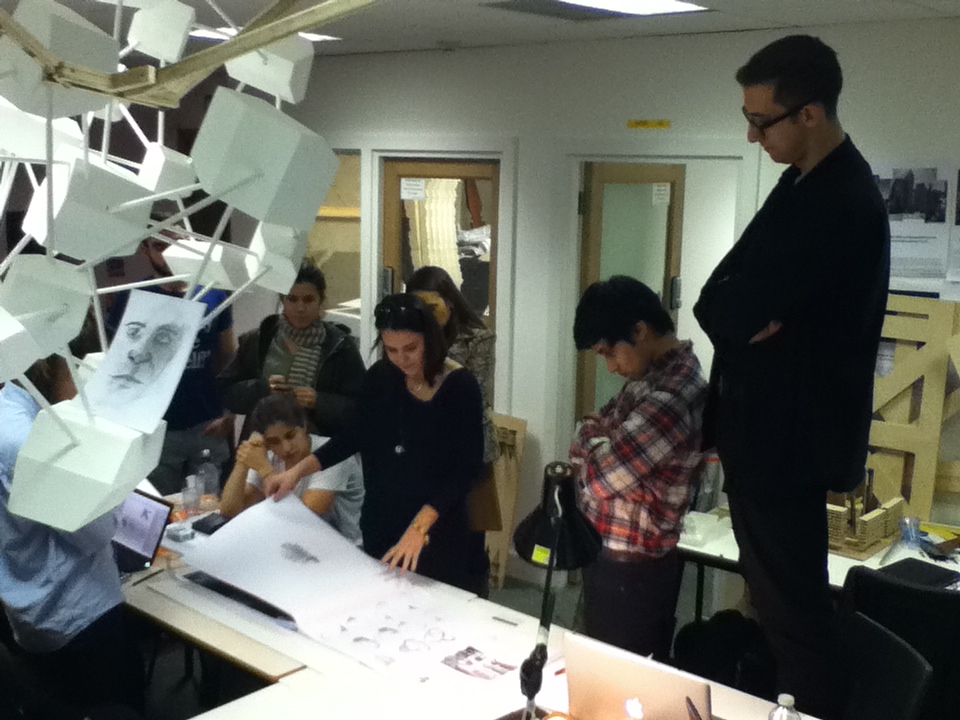
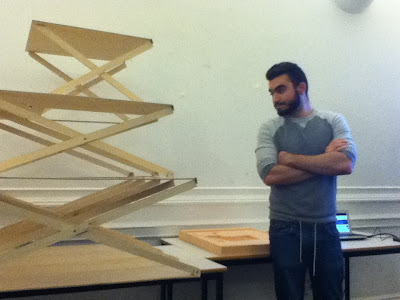
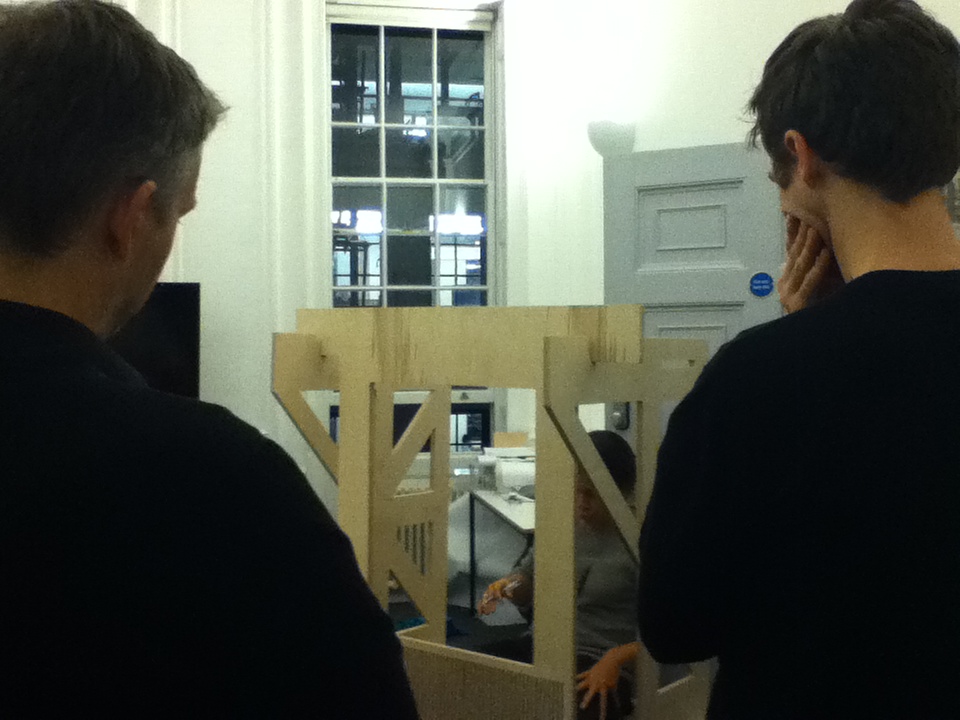
The external crits will be Esther Rivas Adrover (UEL), Theo Lorenz & Tanja Siems (AAIS), PierAndrea Angius (DRL, Zaha Hadid), Tommaso Franzolini (AAVS Ivrea), Kostas Grigoriadis (Diploma 2), Javier Castanon (AA Diploma TS director), Manuel Collado & Nacho Martin (Mi5), Adam Kaasa (LSE) & Brett Steele.The presentation of the whole work, including last term, will be shown on the screen. Each of you have 15 min to explain the project. Some drawings (the key ones) could be printed. Models of Frame and Action should be a fundamental part of your presentation.